- A minimum of 24 months of sea service as an Officer of the Watch where not less than 12 months of such seagoing service has been served as Chief Mate;
- A minimum of 12 months of cumulative sea service as a an Officer of the Watch, as indicated in their seaman book.
- A minimum of 36 months of cumulative sea service as AB, as indicated in their seaman book.
- A minimum of 24 months of cumulative sea service as Deck Cadet, as indicated in their seaman book.
- A minimum of 24 months of sea service, counted from the first sea service of having the Second Engineer Certificate of Competency, where not less than 12 months of such seagoing service has been served as Second Engineer.
- A minimum of 12 months of cumulative sea service as an Officer of an Engineering Watch, as indicated in their seaman book.
- A minimum of 36 months of cumulative sea service as Oiler, as indicated in their seaman book.
- A minimum of 24 months of cumulative sea service as Engine Cadet, as indicated in their seaman book.
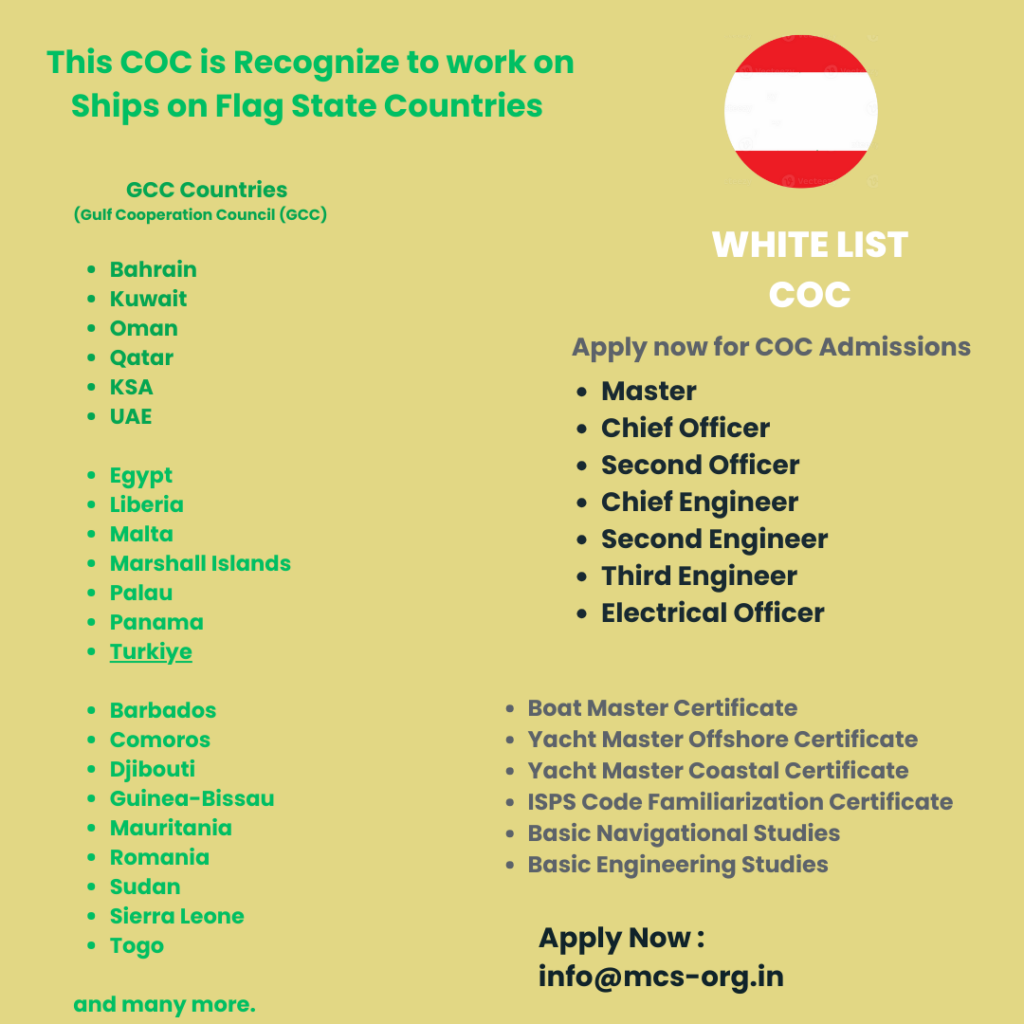
The Boat Master certificate is tailored for individuals willing to possess a foundational understanding of small crafts up to 13.8 meters in length. This comprehensive course equips participants with advanced knowledge in various critical areas, including the Boat structure, safety equipment’s, buoyage systems, boat handling and maneuvering.
Operating a Yacht involves more than just commanding it; a Yacht Master bears a multitude of responsibilities. As an accomplished leader, the captain must exhibit exceptional communication skills when interacting with the crew, the proprietor, and various regulatory bodies.
Within the realm of Yacht Captains, the role encompasses execution of voyages aligned with the expectations of owners or charters, orchestration of vessel upkeep, financial oversight, and unwavering commitment to upholding safety protocols in adherence to global maritime standards.
Moreover, candidates should substantiate their eligibility through a wealth of maritime experience and a profound nautical acumen, substantiated by documented evidence of practical sea service meticulously logged within their personal logbook.
A candidate holding a Yacht Master Offshore Restricted certificate is required to operate a yacht with a maximum length of 35 meters. The sailing activities can take place either during the day or at night, but the yacht must not venture more than 60 nautical miles away from the shore during its voyage.
Operating a Yacht involves more than just commanding it; a Yacht Master bears a multitude of responsibilities. As an accomplished leader, the captain must exhibit exceptional communication skills when interacting with the crew, the proprietor, and various regulatory bodies.
Within the realm of Yacht Captains, the role encompasses execution of voyages aligned with the expectations of owners or charters, orchestration of vessel upkeep, financial oversight, and unwavering commitment to upholding safety protocols in adherence to global maritime standards.
Moreover, candidates should substantiate their eligibility through a wealth of maritime experience and a profound nautical acumen, substantiated by documented evidence of practical sea service meticulously logged within their personal logbook.
A candidate holding a Yacht Master Coastal certificate is required to operate a yacht with a maximum length of 24 meters. The sailing activities can take place either during the day or at night, but the yacht must not venture more than 20 nautical miles away from the shore during its voyage.
The ISPS Code Familiarization Course is an essential component of our maritime education program, specifically designed to prepare individuals for the critical task of ensuring maritime security onboard ships and shoreside. This course is tailored to meet the requirements of the International Ship and Port Facility Security (ISPS) Code, a global framework established by the International Maritime Organization (IMO) to enhance the security of ships and port facilities.
The Navigational Basic Studies Program stands as the cornerstone of our maritime education offerings, providing a comprehensive and in-depth exploration of the art and science of navigation. This program is meticulously designed to shape individuals into skilled navigators equipped to handle the complexities of modern maritime navigation.
Spanning three years, the program is divided into two distinct phases. The first two years are dedicated to theoretical training, where students delve into a rich curriculum encompassing subjects such as celestial navigation, navigation systems, meteorology, and maritime law. With a total of 74 credits thoughtfully distributed over this period, students gain a deep understanding of the theoretical aspects of navigation.
Following the rigorous academic phase, students transition into a year of practical training as Deck Cadets, where they apply their knowledge in real-world maritime scenarios. This hands-on experience, combined with the theoretical foundation, ensures that graduates of the Navigational Basic Studies Program are not only well-versed in navigation theory but also proficient in the practical skills required for safe and successful seafaring.
Upon completing this program, our students emerge as competent and confident navigators, prepared to embark on rewarding careers onboard commercial ships, cruise ships, or in other maritime roles where precision navigation is paramount. The Navigational Basic Studies Program is the compass that guides individuals toward a promising and fulfilling journey in the maritime world.
The Engineering Basic Studies Program stands as the cornerstone of our maritime education offerings, providing a comprehensive and in-depth exploration of the vital engineering principles that power the maritime industry. This program is meticulously designed to equip individuals with the knowledge and skills necessary to excel as proficient marine engineers.
Spanning three years, the program is divided into two distinct phases. The first two years are dedicated to rigorous theoretical training, where students delve into a rich curriculum encompassing subjects such as marine propulsion systems, electrical and mechanical systems, thermodynamics, and maritime engineering ethics. With a total of 74 credits thoughtfully distributed over this period, students gain a deep understanding of the theoretical aspects of marine engineering.
Following the intensive academic phase, students transition into a year of practical training, as Engineering Cadets, where they apply their knowledge in real-world maritime engineering scenarios. This hands-on experience, combined with the strong theoretical foundation, ensures that graduates of the Engineering Basic Studies Program are not only well-versed in marine engineering theory but also proficient in the practical skills required to maintain and operate marine machinery effectively.
Upon completing this program, our students emerge as competent and confident engine cadet, prepared to embark rewarding careers onboard commercial ships, cruise ships, or in other maritime roles where the reliability and efficiency of maritime machinery are paramount. The Engineering Basic Studies Program is the engine that propels individuals toward a promising and fulfilling journey in the maritime engineering field.